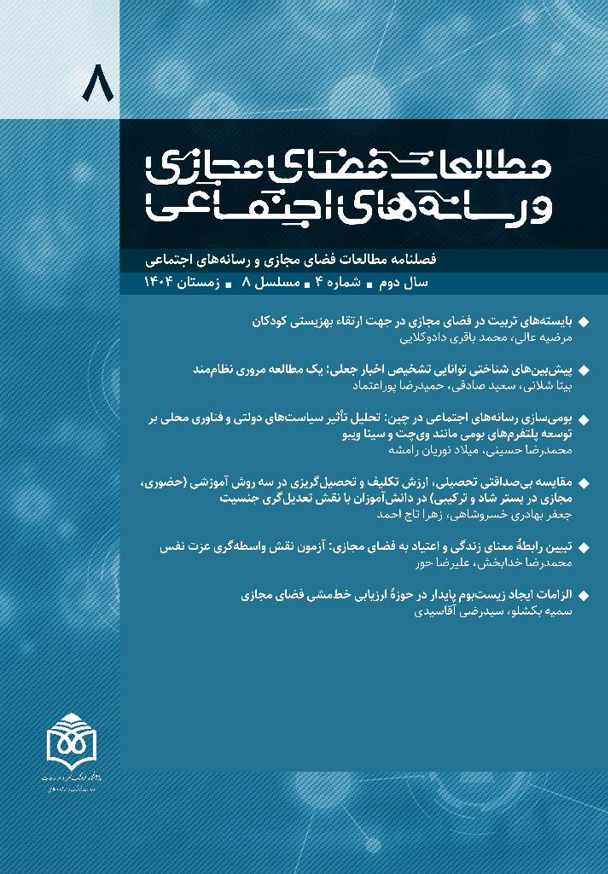
نوع مقاله : مقاله پژوهشی
عنوان مقاله English
نویسندگان English
Introduction: The proliferation of social media platforms has transformed the landscape of human interaction, offering unprecedented opportunities for communication, identity expression, and information exchange. However, the same platforms-engineered for instant gratification, algorithmic personalization, and social validation-have also given rise to compulsive usage patterns, often culminating in behavioral addiction. Social media addiction (SMA) is increasingly recognized as a psychological concern, particularly among youth and university students, manifesting in symptoms such as preoccupation, withdrawal, and impaired functioning. In parallel, existential psychology underscores the importance of “meaning in life” (MIL) as a foundational element of psychological well-being. Individuals who perceive their lives as meaningful tend to demonstrate greater emotional resilience, purpose-driven behavior, and reduced susceptibility to maladaptive coping strategies. Despite its theoretical relevance, MIL has received limited empirical attention in the context of SMA. Moreover, self-esteem-a person’s subjective evaluation of self-worth-may serve as a psychological buffer, mediating the relationship between existential fulfillment and addictive behaviors. This study aims to bridge these gaps by examining the direct and indirect effects of MIL on SMA, with self-esteem as a mediating variable. The research is situated within the Iranian cultural context, contributing to localized mental health strategies and culturally sensitive interventions.
Methods: This study employed a quantitative, cross-sectional design to explore the hypothesized relationships among MIL, self-esteem, and SMA. A total of 214 participants (aged 18–40) were recruited through convenience sampling from social media users in Iran. Inclusion criteria required active engagement with social media platforms and fluency in Persian. Participants completed three standardized instruments: the Meaning in Life Questionnaire (MLQ), which assesses the presence of and search for meaning; the Rosenberg Self-Esteem Scale (RSES), a widely validated measure of global self-worth; and the Social Media Addiction Scale (SMAS), which evaluates compulsive and problematic social media use. Data analysis was conducted using SPSS software, incorporating Pearson correlation coefficients to assess bivariate relationships, multiple regression analysis to test predictive pathways, and mediation modeling based on Baron and Kenny’s approach. Additionally, structural equation modeling (SEM) was employed to validate the proposed model and assess its fit using indices such as RMSEA and CFI.
Results: Descriptive statistics indicated moderate levels of social media use and self-esteem across the sample, with a wide distribution in perceived meaning in life. Correlational analysis revealed a significant negative relationship between MIL and SMA (r = –0.42, p < 0.01), suggesting that individuals with higher existential fulfillment reported lower levels of social media addiction. Similarly, self-esteem was negatively correlated with SMA (r = –0.38, p < 0.01), indicating that higher self-worth is associated with reduced compulsive social media engagement. Regression analysis confirmed that MIL significantly predicted SMA, and that self-esteem also served as a significant predictor. Mediation analysis demonstrated that self-esteem fully mediated the relationship between MIL and SMA. In other words, MIL enhances self-esteem, which in turn reduces susceptibility to SMA. The SEM model showed strong fit indices (RMSEA = 0.05, CFI = 0.94), supporting the robustness of the proposed theoretical framework.
Discussion: The findings underscore the protective role of existential and self-concept variables in mitigating problematic social media use. Meaning in life emerges as a foundational psychological resource that fosters self-worth and buffers against compulsive digital engagement. The full mediation effect of self-esteem highlights its centrality in translating existential fulfillment into behavioral regulation. These results align with existential and positive psychology frameworks, which posit that individuals with a strong sense of purpose and self-worth are less likely to engage in maladaptive behaviors. From a theoretical standpoint, this study integrates existential psychology with behavioral addiction models, offering a multidimensional understanding of SMA. It moves beyond surface-level predictors such as screen time or platform type, and instead emphasizes deeper psychological constructs that shape digital behavior. Practically, the findings advocate for intervention programs that simultaneously cultivate life meaning and enhance self-esteem. Such programs may include narrative therapy, mindfulness-based interventions, and psychoeducational workshops aimed at fostering purpose, identity coherence, and self-acceptance. Importantly, the study contributes to culturally contextualized research by exploring these dynamics within an Iranian sample. Given the sociocultural nuances of digital engagement in Iran-where social media often serves as a primary outlet for self-expression and social connection-the findings hold particular relevance for mental health practitioners and educators. Future research should consider longitudinal designs to examine causal relationships, diversify sampling across regions and demographics, and explore additional mediators such as emotional regulation, social connectedness, or personality traits. In conclusion, the study provides compelling evidence that meaning in life and self-esteem are critical psychological buffers against social media addiction. By illuminating the mediating role of self-esteem, it offers a nuanced pathway for understanding and addressing compulsive digital behavior in young adults. These insights pave the way for more holistic, culturally sensitive, and psychologically grounded approaches to digital wellness.
کلیدواژهها English