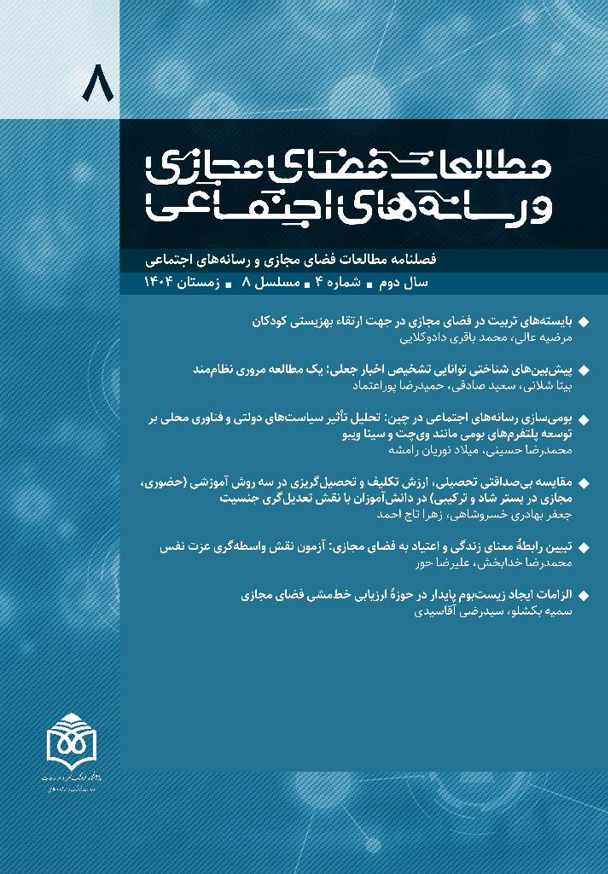
نوع مقاله : مقاله پژوهشی
عنوان مقاله English
نویسندگان English
Introduction: In recent decades, the rapid expansion of digital media and virtual spaces has emerged as a major determinant of contemporary human lifestyles, particularly among children. From an early age, children are increasingly exposed to digital technologies, and substantial aspects of their learning processes, play, social interactions, and even emotional development occur within digital environments. Despite the educational and cultural opportunities afforded by these media, excessive, unbalanced, or unsupervised use may result in a range of adverse physical, psychological, and social outcomes. Consequently, examining the relationship between children’s engagement with virtual spaces and their digital well-being, as well as clarifying the educational roles of parents and teachers in addressing this phenomenon, has become both a scientific priority and a social necessity.
Methodology: This study employed a systematic review methodology. A total of 22 relevant studies addressing “children’s well-being in virtual spaces,” “educational implications of digital media,” and “parental and teacher strategies for managing children’s online engagement” were retrieved from international academic databases, including Google Scholar and ScienceDirect. Following a screening process based on predefined inclusion and exclusion criteria-namely recency of publication, focus on childhood, and inclusion of both genders-19 articles were selected for final analysis. Data were coded using qualitative content analysis, and reliability was established through Cohen’s Kappa coefficient (κ = 0.77), indicating a high level of inter-coder agreement.
Findings: The systematic review indicated that the factors influencing children’s digital well-being can be categorized into external and internal dimensions.
• External factors: These factors include the nature and quality of media content, the duration of screen time, the supervisory and participatory roles of parents and teachers, the family’s level of educational attainment and media literacy, and the child’s cultural and peer environment. The findings demonstrate that increased parental and teacher involvement in children’s digital activities, combined with balanced regulation of screen time, significantly reduces psychological and behavioral risks.
• Internal factors: These encompass individual characteristics such as self-control, self-regulation, cognitive and emotional development, and perceptions of body image. Children who exhibit higher levels of emotional regulation, self-awareness, and cognitive understanding tend to demonstrate greater resilience to the negative effects of virtual environments.
Overall, the findings suggest that balanced and guided use of digital media can generate positive outcomes, including the development of cognitive skills, improved technological literacy, enhanced social communication, and the promotion of self-directed learning. In contrast, excessive or unsupervised media use is associated with negative consequences such as depression, anxiety, sleep disturbances, obesity, low self-esteem, and increased aggression.
Conclusion: Virtual space constitutes an inevitable dimension of children’s lives-one that cannot be avoided, yet should not be accepted uncritically. This study demonstrates that maintaining children’s digital well-being depends on the integration of media education, digital literacy, and the quality of children’s real-life experiences. Children raised in safe, emotionally supportive, and culturally enriched environments are more likely to display balanced and conscious behaviors in virtual spaces.
Accordingly, the most effective strategy is not restrictive prohibition, but rather informed and active engagement by parents and teachers, which includes: • Transforming passive supervision into active participation within digital environments; • Teaching media literacy and critical thinking skills; • Strengthening real-life relationships and psychological well-being at home and school; • Regulating screen time and ensuring access to age-appropriate media content.
Ultimately, children’s digital well-being can be realized when policymakers, educational systems, and families adopt a comprehensive and preventive approach that facilitates the safe, purposeful, and developmentally appropriate use of the virtual world for future generations.
کلیدواژهها English